
BOJIDAR IKONOMOV
BOJIDAR IONOV
LIUDMIL TCHEKHLAROV
DANISH MUSEUM
OF POSTERS AARHUS
June - August 2004, Aarhus, Danmark
organized by
DANISH MUSEUM OF POSTERS
AARHUS
with the assistance
CULTURFOREING DANMARK-BULGARIA
&
THE INTERNATIONAL TRIENNIAL
OF THE STAGE POSTER, SOFIA
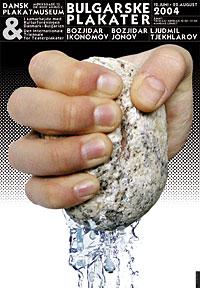
TThere is a Bulgarian saying which brings the message for physical force:"To crush a stone and get water". This force could be also the power of will, love and spirit.
These particular qualities, along with the sense of humour, were extremely necessary in the long years of totalitarism. The only possible language then was the Aesopian allegorical language, and thus the truth said on a second plan could pass by the sensor. This happened in the easiest way in theatres where most of us worked. In that way for more than 30 years we have been turning the brakes and problems into quality and our group of young artists at that time managed to create the image of the Bulgarian stage poster. The awards and successes it brought along the years went mainly to the cultural stage poster. The social poster was then called political; it was very strictly observed and often mediocre. The advertising poster of course did not exist at all. Who cared about advertisements in communism - the market was poor and there was no competition. What was present was the nook of culture and especially the freedom of the bohema and the theatre society. All theatres in the capital city and in the country made many stage posters of high quality. In 1974 a Biennial of the Bulgarian Stage Poster was founded. It united all the creative work done in the years preceding the system's collapse. In 1990 a chaos occurred in Bulgaria and in the other socialist countries; in their economical, social and cultural life.
In 1994 in Sofia we founded a private Triennial of the Stage Poster. Our idea was to restore the theatre fans' fancy toward the stage poster. In October this year The Fourth Triennial of Stage Poster will take place in Sofia. Stage posters from all over the world will participate in it creating a variegated and diverse picture of emotions and traditions. These stage posters bring us hope that the stage poster's art revives and attracts again the public's interest.
I am convinced that the good poster is first of all a mode of thinking, an idea. The artists should find his own clear and challenging formule, his own style and approach to the public. The artist should create the graphic equivalent of the message, based in the work of art or the event, a vision ballanced among the sense of humour and a depth, coded in the message. The artist should feel himself a co-author to the authors of performances, pictures, festivals, and to give a meaning by enough self-irony for the short life of the printed sheets. But he should be convinced that he creates art, which although meant for the street, has already entered museums and galleries. This art is not only a facade of the theatre but also its memory.
Along with my colleagues Liudmil Tchekhlarov and Bojidar Ionov I was among those young artists 30 years ago. I hope that the exhibition which we present in the famous Museum of the Poster in Aarhus will allow the public to touch the art of the Bulgarian poster, see its development throughout the years and become partial to the power of our feelings and ideas which I hope are still young today.
I thank most cordially Mr. Peder Stougaard and Helle Dalgaard for their hospitality, for the wonderful organization and the possibility to show Bulgarian art in the heart of Europe. I hope it will reach your hearts too.
Bojidar Ikonomov
I had managed to convince Peder Stougaard that Bulgarian posters did not merely convey a political message, but had artistic value too. We approached the Bulgarian Ministry of Culture; their response was positive and it was the Ministry itself that selected the posters to be displayed. The Danish organisers had no say in the matter, nor was there a possibility to contact the artists.
The viewers' reaction was favourable: they were surprised, they observed and commented on the broad spectrum of themes and colours: in a world, Bulgarian posters proved a success in Aarhus back in the mid 1980s. Of course, the exhibition showed examples of social realism - as a state of mind and a state of art - but also of much fantasy and clever distortions.
In communist Bulgaria a lot of ideologically tinted posters were produced - it couldn't have been otherwise. Posters express an attitude; attitude is ideology and that particular ideology was communist.
But at the end of the 1970s what captured my eye and my mind was the colours, the warmth and vivacity, and the very high artistic and technical level, the combination of realism and fantasy in those posters for theatre performances, films, festivals, etc. Many were genuine works of art and not just conveyors of a message. The Bulgarian artists were obviously influenced by the Polish school of poster-design, but both their vigour and their joy melancholy were strikingly Balkan in essence - their art maybe not as elegant as the Polish, but much more vigorous.
Today, almost 20 years after, modern Bulgarian posters - 150 of them - are again on display at the Danish Museum of Posters. This time by three artists, specially selected, with whom I have been in contact on behalf of the Museum: artists who themselves have chosen the posters for the exhibition. These three artists were also well represented at the small exhibition back in 1986. But at that time they did not even know that their posters were shown in Denmark. This is just one of the differences between then and now.
Another marked difference is the terms of the poster's existence. The political poster has lost its icon status, and since the 1980s, the poster's aesthetic role as a messenger has been weakened both in the East and in the West. The poster's magic mirror has lost its magic powers in the competition with other mirror images. Economic reforms in the new democracies, where the state had the monopoly as a sponsor of the arts, have further aggravated the situation. Art is starved of funding and poster-design has become advertisement-design.
That is why it is so gratifying that these three artists are still going strong and are finding new ways of graphic expression. They speak a sophisticated poster-language - an evidence of strong technical, theoretical and cultural foundations.They carry on the tradition both at International exhibitions and at the International Triennial of Stage Poster in Sofia.We hope that this exhibition will be an eye-opener.
Helle Dalgaard